Deputy Prime Ministers and other politicians.
- Australia 1901-1988
- New South Wales
- Overview of NSW
- Telegraph lines
- Telegraph Offices
- Date stamps
- Forms
- Envelopes
- Instructional annotation
- Collect
- Delayed
- Free
- Immediate Urgent
- Reply paid
- Rates
- Stamps
- 1871 Telegraph stamps
- 1885 proposal
- 1893 proposal
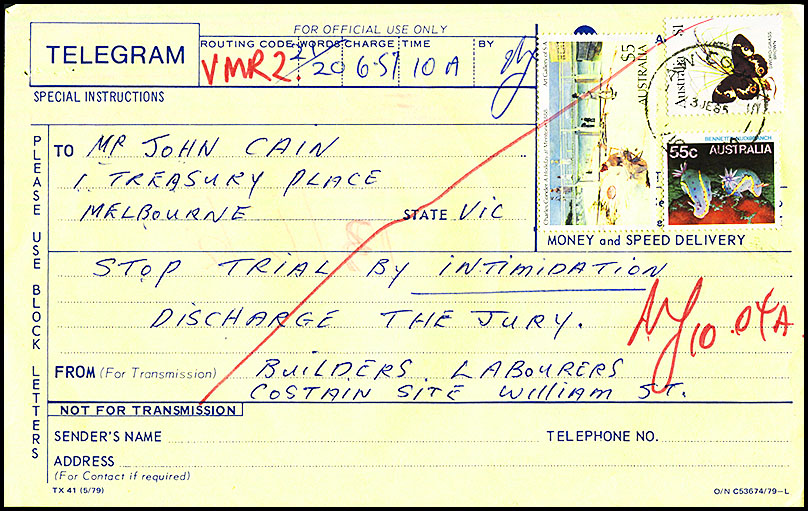
Politicians were required, by the nature of their tasks, to send telegrams about a variety of activities and issues. Telegrams to Prime Ministers are reviewed elsewhere. On this page, telegrams involving Deputy Prime Ministers, Ministers and State Premiers are reviewed.
Some examples are shown below for:
| John Cain (Victoria) |
Charles Court (Western Australia) |
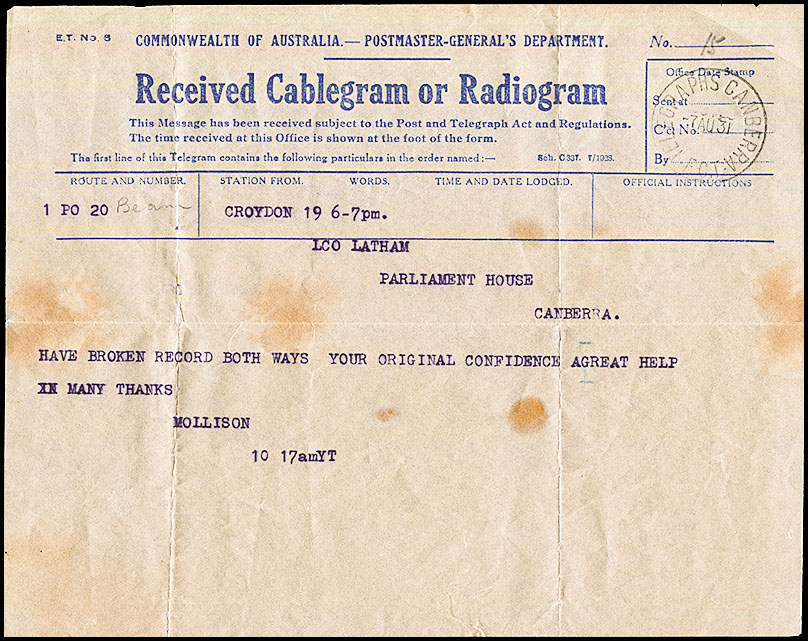
John G. Latham (Federal) |
|
| Neville Wran (N.S.W.) |
Private Secretary in the mid-1890s to Tasmania Governor Jenico Preston. |
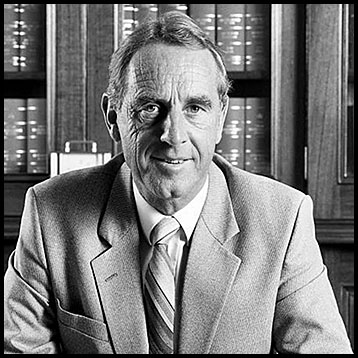
John Cain: John Cain served three terms as Premier of Victoria: He was the longest lived Premier of Victoria. Full details about John Cain can be retrieved elsewhere. |
 |
|
|
| John G. Latham. Nationals/United Australia Party. 1877 to 1964. As his career developed, Latham was appointed secretary of the Victorian branch of the Universal Service League on its formation in 1917. Soon after, following allegations of sabotage in the naval dockyards, he was appointed head of Naval Intelligence with the honorary rank of Lieutenant-Commander. He first stood for Parliament in 1922 in the seat of Kooyong as an Independent Liberal Union candidate. In 1925, he joined the National Party and became Attorney-General. In 1929, he helped formulate legislation which would cede to the States responsibility for industrial regulation except for the maritime industry. That move was unsuccessful and the Government lost at the October 1929 election. At the Election, Bruce lost his seat and Latham became Leader of the Nationalists and so was Leader of the Opposition for the next 18 months. He stepped down from leadership in favour of Joseph Lyons in 1931 and the United Australia Party was formed. The UAP won the election at the end of 1931 and he was appointed Attorney-General and Minister for External Affairs and Industry at the beginning of 1932. |
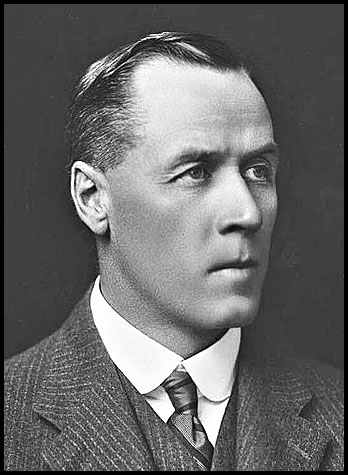 |
In 1934 Latham retired from politics and was appointed Chief Justice of the High Court in October 1935 where he served until 1952. Legislation passed in 1940 enabled Latham to become Australia's first minister to Japan while still Chief Justice. He served in Japan from the end of 1940 to September 1941. Full details about John G. Latham can be retrieved elsewhere. |
|
James Mollison was born on 19 April 1905 in Glasgow. He obtained his RAF Short Service Commission at the age of 18. Although he gained a reputation as a playboy, Mollison approached his aviation with intent:
|
|
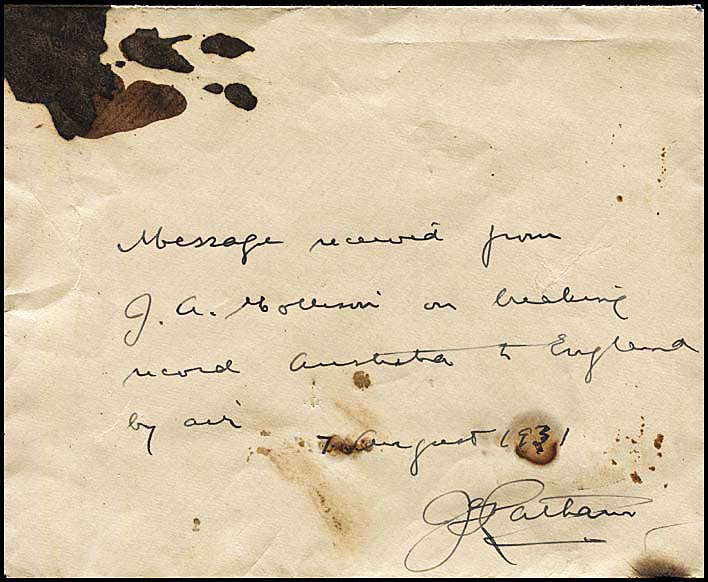 The cover which Latham would have used to keep the cover - and signed by him. |
|
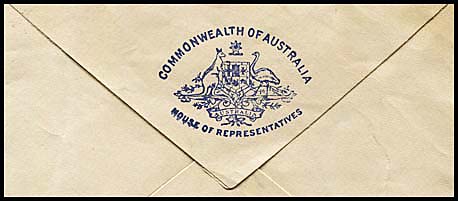 The flap on the reverse of Latham's cover. |
|

|
Neville Wran was first elected to Parliament on 17 November 1973 when he won the seat of Bass Hill. He became Premier when the Labor Party defeated the Liberal Party Premier Sir Eric Willis by two seats (Gosford which Labor won by 74 votes and Hurstville with Labor winning by 44 votes). That win was in May 1976 - six months after the dismissal of the Whitlam Government. Wran won three subsequent elections - in 1978, 1981 and 1984. At one stage, he held an 84% approval rating of voters. Neville resigned as Premier and from his seat of Bass Hill on 4 July 1986. By then he had continuously held the office of Premier longer than any other premier in the history of New South Wales (10 years and 81 days). His accomplishments include instituting a democratic Legislative Council, held Commissions of Inquiry into police administration and into gambling, undertook the state's largest capital works program which included building the present Darling Harbour precinct. In 1984, Wran introduced a private member's Bill to decriminalise adult gay male sex (the Bill passing the NSW Parliament). He considered "saving the rainforests" as his greatest achievement. His most remembered quote is perhaps the statement he uttered in his June 1983 speech to the ALP Annual Conference - Balmain boys don't cry. |
 Telegram sent on 15 June 1976 by Premier Neville Wran to Mr. J. W. Davies to congratulate him for his Imperial Service Order award. From the collection of Mr. Davies' daughter Ms. Jan Curran. Also see other telegrams from Prime Minister Malcolm Fraser and N.S.W. Governor Sir Roden Cutler. The date stamp for Miranda is rated RARE. |